The Recurrence Barrier
Modern CPU microarchitectures feature wide vector units: - ARM64 NEON: 128-bit registers (4 single-precision floats or 2 double-precision floats). - x86 AVX2: 256-bit registers (8 single-precision floats or 4 double-precision floats). - x86 AVX-512: 512-bit registers (16 single-precision floats or 8 double-precision floats).
In theory, SIMD execution can deliver between \(4\times\) and \(16\times\) raw arithmetic throughput compared to scalar code.
In practice, however, many algorithms in engineering, physics, and AI fail to vectorize. The primary obstacle is the loop-carried data dependency.
What is a Loop-Carried Dependency?
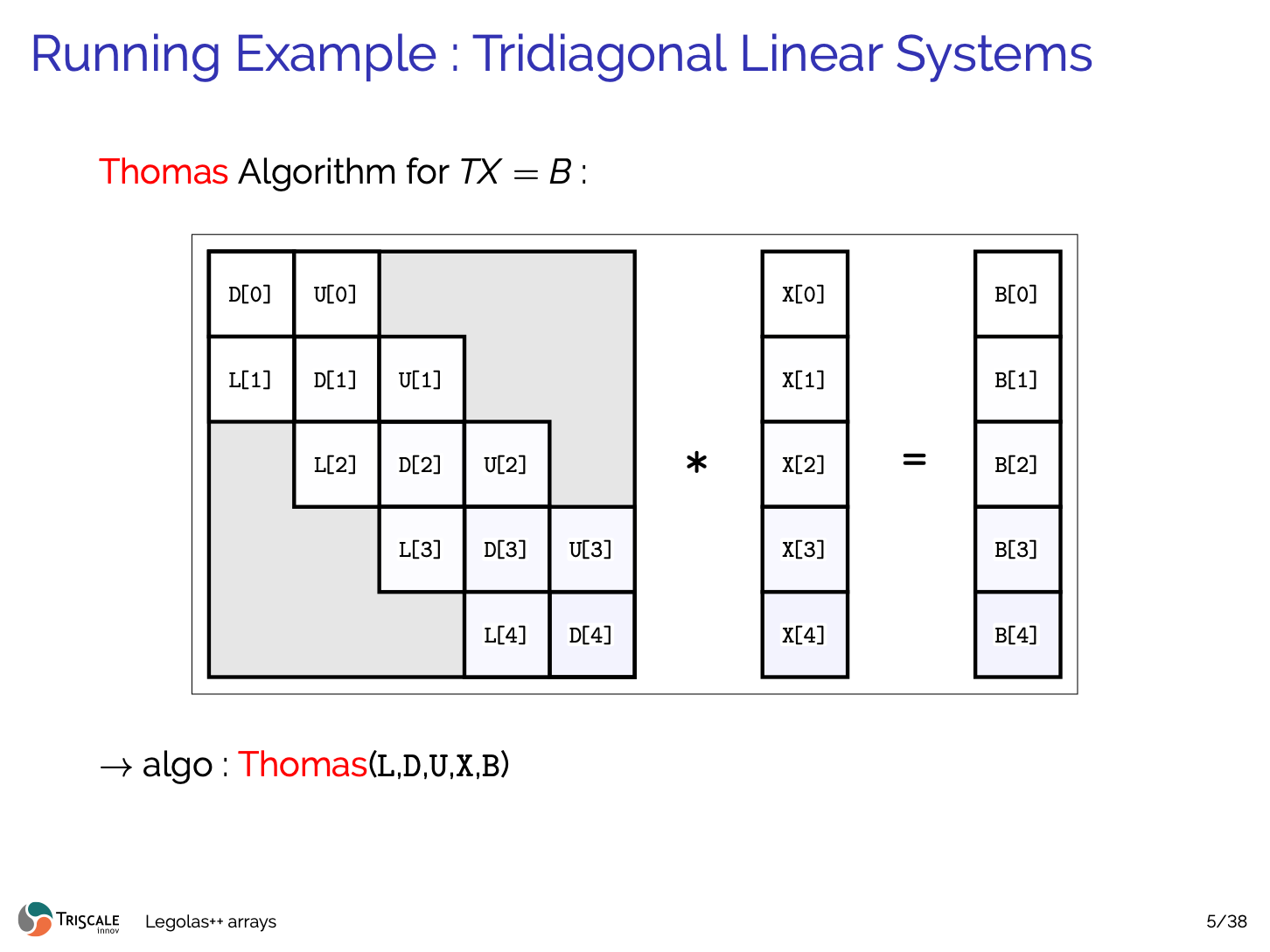 Figure 1: Tridiagonal linear system \(TX = B\) with matrix bands \((L, D, U)\), solution vector \(X\), and right-hand side \(B\).
Consider the forward sweep of the classic Thomas algorithm for tridiagonal systems \(T x = b\), or a 1st-order IIR filter:
Notice that computing \(X[i]\) requires the value \(X[i-1]\) calculated in the immediately preceding iteration.
 Figure 2: Sequential recurrence chain — iteration \(i\) is strictly dependent on the result of iteration \(i-1\).
Because iteration \(i\) cannot start before iteration \(i-1\) has finished, the instructions must execute sequentially. The CPU cannot pack multiple iterations of \(i\) into a SIMD vector register.
Why Auto-Vectorizers Give Up
When an optimizing compiler (Clang, GCC, MSVC, Intel oneAPI) inspects this loop: 1. It builds a data dependency graph. 2. It detects a true data dependency (Read-After-Write, RAW hazard) across loop iterations. 3. It emits a diagnostic report:
remark: loop not vectorized: cannot prove it is safe to reorder floating-point operations
remark: loop not vectorized: value is used outside the loop / recurrence detected
Even aggressive compiler pragmas like #pragma omp simd or #pragma GCC ivdep cannot help: reordering the operations would alter the mathematical recurrence and produce invalid numerical results.
Where Do Recurrences Occur?
| Domain | Algorithm | Recurrence Nature |
|---|---|---|
| PDEs & Physics | Alternating Direction Implicit (ADI), Crank-Nicolson | Tridiagonal / Pentadiagonal systems along mesh lines |
| Digital Signal Processing | IIR Biquad Equalizers, Crossovers, Audio FX | Temporal feedback \(y[n] = f(y[n-1], y[n-2])\) |
| Geophysics & Wave Modeling | Acoustic & Elastic Wave Equations | Implicit spatial sweeps along grid dimensions |
| Deep Learning | Selective State Spaces (Mamba, S4, Linear RNNs) | Causal hidden state updates \(h_t = A h_{t-1} + B x_t\) |
| Computer Vision | Depthwise Separable Convolutions | Channel-independent spatial filtering with short loops |
The Way Forward
To vectorize these algorithms, we must look beyond a single problem instance. In real applications, we almost never solve a single recurrence in isolation—we solve hundreds or thousands of them.
Legolas++ exploits this higher-level parallelism by interleaving data across problem instances at the memory layout level.